
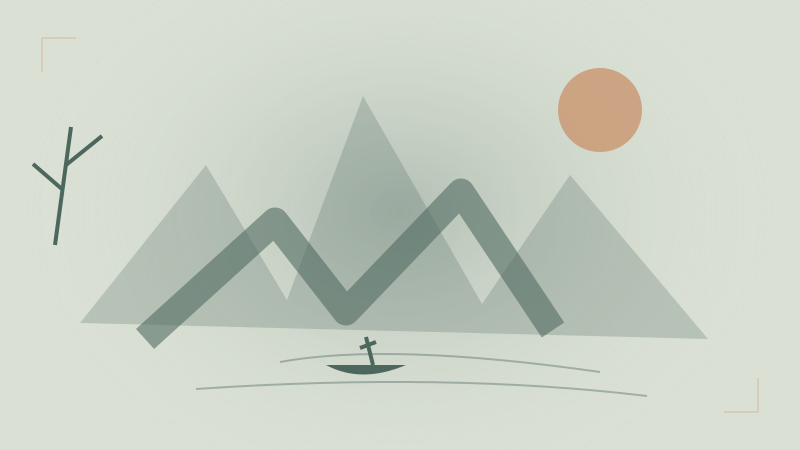
Ink-wash animation asks a compelling visual question: how can the softness of a painted image survive movement? Instead of treating a figure only as a hard outline around a solid colour, an ink-based image can invite attention to fading edges, variations in tone, and the space around a subject.
Two starting points
The BFI discusses Te Wei’s Where Is Mama? (also known as Tadpoles Look for Mother, 1960) in relation to Qi Baishi’s painting. Annecy records Feeling from Mountain and Water (山水情, 1988) as water-ink drawing on paper, directed by Te Wei, Ma Kexuan and Yan Sanchun and produced by Shanghai Animation Film Studio.
Let the frame breathe
For your own viewing, try following the relation between a small figure and the landscape around it. An open area of the frame can direct attention as clearly as a detailed object. Listen for how music changes your sense of distance and pace. A quieter passage can be worth watching twice: once for movement and once for the spaces that remain still.
Style and process are different questions
An image that resembles ink painting does not, by itself, tell you how the production was made. Traditional materials, digital tools, or combinations can create related visual effects. Check a film’s technical record before describing its process. Annecy’s archive is useful here because it separates the production year, directors, technique and other credits from the plot description.
Take one observation into the discussion
Instead of calling a film simply beautiful, describe a particular transition, edge, pause, or relationship between foreground and background. That gives another viewer something concrete to look for and makes a conversation about animation more rewarding.
Sources & further reading
Annecy Festival — Feeling from Mountain and Water ↗
British Film Institute — Te Wei and Chinese animation ↗
Annecy Festival — Chinese animation in the 1960s ↗
Original Atlas knowledge feature. Historical dates refer to the works or events described. References checked on 11 October 2026; viewing prompts are Atlas editorial suggestions.